Here are quotes that I have collected, but have nowhere else to place purposefully at the moment:
cicero
Cicero“A room without books is like a body without a soul.”
steve brown
Steve Brown“Anything worth doing is worth doing poorly - until you learn to do it well.”
chopin
Chopin“Simplicity is the final achievement. After one has played a vast quantity of notes and more notes, it is simplicity that emerges as the crowning reward of art.”
this page is now a pointer to Analytic (the tag).
not all books are read with equal rigour. these one’s have been read analytically1
another conception of this tag is in being the final stage in Tiago Forte’s “progressive summarisation”.
footnotes
as per Mortimer J. Adler’s definition of the term in How to Read a Book. ↩︎
facts and patterns of behaviour regarding the following religions for the sake of understanding humans and their societal behaviours more correctly.
Buddhism
Daoism
Islam
Christianity
Judaism
Hinduism
No other forms of mythology fascinate me as much as Greek Mythology does.
I would love to produce a list of spiritual figures, both mortal and im, for the benefit of understanding their strengths, weaknesses, symbolisms and ancestry.
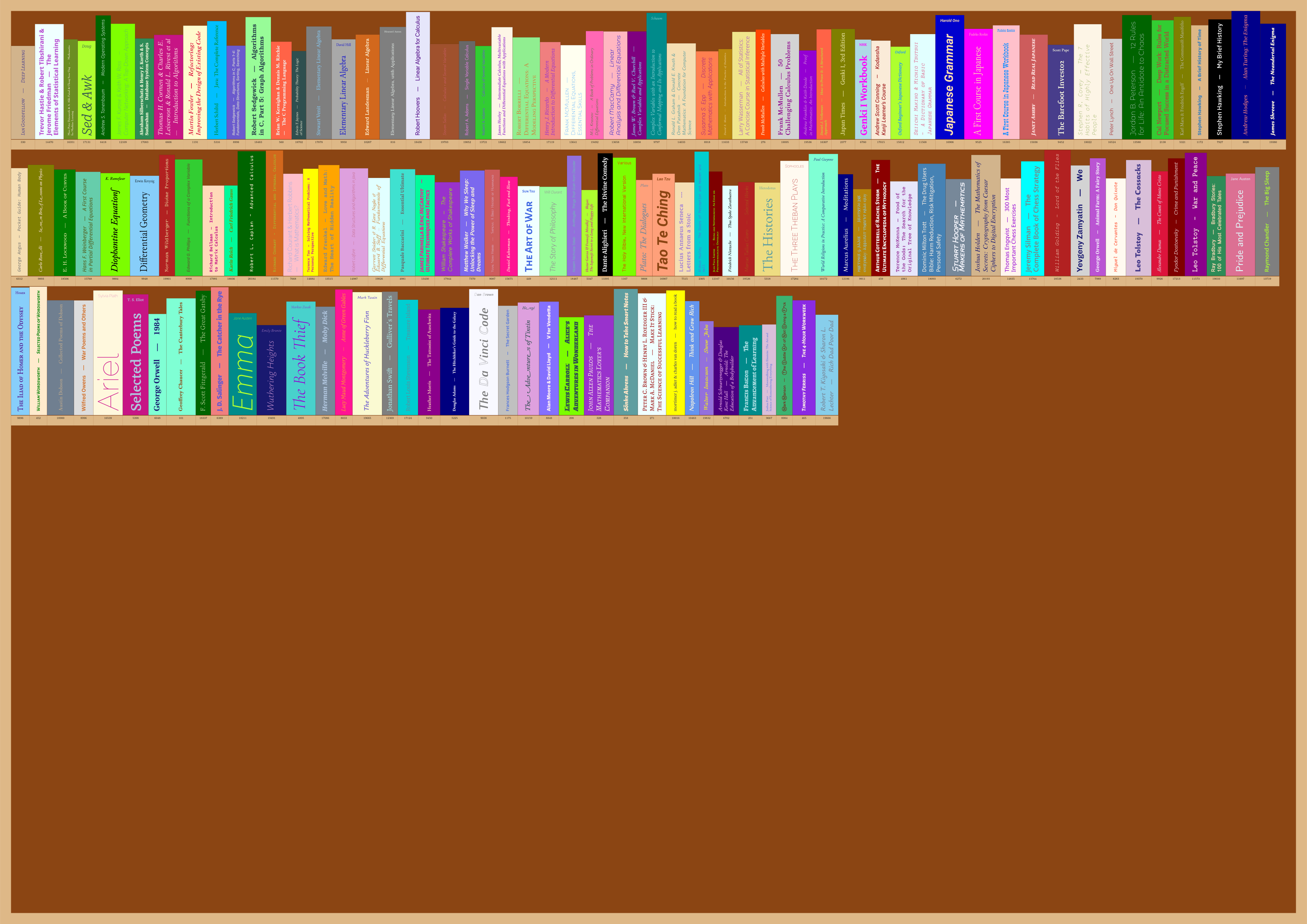
These are all the books that I own / have owned in the past. I have not read them all, neither will I ever be able to.
You walked past the rendered SVG on your way here.
Here is a table of all the research papers I have taken the liberty to print and annotate.
You may find the static directory here.
[1] R. Manna and R. Nath. Kantian moral agency and the ethics of artificial intelligence. Problemos, 100:139--151, 2021. [ .pdf ] [2] R. Nath and V. Sahu. The problem of machine ethics in artificial intelligence. AI & Society, 35:103--111, 2021. [ .pdf ] [3] R. Tonkens. A challenge for machine ethics. Minds & Machines, 19:421--438, 2009. [ .pdf ] [4] L. Singh. Automated kantian ethics: A faithful implementation, 2022. Online at https://github.com/lsingh123/automatedkantianethics. [ .pdf ] [5] European Commission's High-Level Expert Group on Artificial Intelligence. Ethics guidelines for trustworthy artificial intelligence. Technical Report 6, European Commission, 2019. p. 17. [ .pdf ] [6] J. Fjeld, N. Achten, H. Hilligoss, A. C. Nagy, and M. Srikumar. Principled artificial intelligence: Mapping consensus in ethical and rights-based approaches to principles for ai. arXiv preprint arXiv:2009.06350, 2020. [ .pdf ] [7] M. M. Bentzen and F. Lindner. A formalization of kant's second formulation of the categorical imperative, 2018. [ arXiv | .pdf ] [8] Tom M. Powers. Prospects for a Kantian machine. IEEE Intelligent Systems, 21(4):46--51, 2006. [ .pdf ] [9] Christopher Bennett. What Is This Thing Called Ethics?, chapter 4--6. Routledge, London, 2015. Chapters on Utilitarianism, Kantian Ethics, and Aristotelian Virtue Ethics. [10] Masaki Nakagawa. Deep learning for classical japanese literature. 2018. kmnist. [ .pdf ] [11] Warren S. McCulloch and Walter Pitts. A logical calculus of the ideas immanent in nervous activity. 1943. McCulloch-Pitts Model, perceptron. [ .pdf ] [12] Leland McInnes, John Healy, and James Melville. Umap: Uniform manifold approximation and projection for dimension reduction. 2020. [ .pdf ] [13] Christian Szegedy, Wojciech Zaremba, and Ian Goodfellow. Intriguing properties of neural networks. 2014. [ .pdf ] [14] Alec Radford, Jeffrey Wu, Rewon Child, David Luan, Dario Amodei, and Ilya Sutskever. Language models are unsupervised multitask learners. 2019. GPT-2. [ .pdf ] [15] Alec Radford, Karthik Narasimhan, Tim Salimans, and Ilya Sutskever. Improving language understanding by generative pre-training. 2018. GPT. [ .pdf ] [16] Ashish Vaswani, Noam Shazeer, Niki Parmar, Jakob Uszkoreit, Llion Jones, Aidan N. Gomez, Lukasz Kaiser, and Illia Polosukhin. Attention is all you need. In Advances in Neural Information Processing Systems, 2017. Attention, Transformer. [ .pdf ] [17] Ilya Sutskever, Oriol Vinyals, and Quoc V. Le. Sequence to sequence learning with neural networks. In Advances in Neural Information Processing Systems, 2014. Seq2Seq. [ .pdf ] [18] Karen Simonyan and Andrew Zisserman. Very deep convolutional networks for large-scale image recognition. In International Conference on Learning Representations, 2015. VGGNet. [ .pdf ] [19] Alex Krizhevsky, Ilya Sutskever, and Geoffrey E. Hinton. Imagenet classification with deep convolutional neural networks. In Advances in Neural Information Processing Systems, 2012. AlexNet. [ .pdf ] [20] Kaiming He, Xiangyu Zhang, Shaoqing Ren, and Jian Sun. Deep residual learning for image recognition. In Proceedings of the IEEE Conference on Computer Vision and Pattern Recognition, 2015. ResNet. [ .pdf ] [21] Yann LeCun, Yoshua Bengio, and Geoffrey Hinton. Deep learning. Nature, 521:436--444, 2015. Review: Deep Learning. [ .pdf ] [22] Yann LeCun, Léon Bottou, Yoshua Bengio, and Patrick Haffner. Gradient-based learning applied to document recognition. Proceedings of the IEEE, 1998. LeNet. [ .pdf ] [23] Stephan K. Chalup and Alan D. Blair. Incremental training of first order recurrent neural networks to predict a context-sensitive language. 2003. [ .pdf ] [24] Nicholas Heller and Niranjan Sathiananathen. The kits19 challenge data, 2020. [ .pdf ] [25] Yann LeCun, Bernhard Boser, John S. Denker, Donnie Henderson, Richard E. Howard, Wayne Hubbard, and Lawrence D. Jackel. Handwritten digit recognition with a back-propagation network. 1989. [ .pdf ] [26] Ahmed Taha, Pechin Lo, and Junning Li. Convolution networks for kidney vessels segmentation from ct-volumes. 2018. KidNet. [ .pdf ] [27] Olaf Ronneberger, Philipp Fischer, and Thomas Brox. U-net: Convolutional networks for biomedical image segmentation. In Medical Image Computing and Computer-Assisted Intervention (MICCAI), 2015. UNet. [ .pdf ] [28] Niranjan J. Sathianathen, Nicholas Heller, Samuel Kleppe, James M. Mountney, and Bradley Erickson. Automatic segmentation of kidneys and kidney tumors: The kits19 international challenge. 2022. [ .pdf ] [29] DeepSeek-AI et al. Deepseek-r1: Incentivizing reasoning capability in llms via reinforcement learning, 2025. [ .pdf ] [30] Batya Friedman, Peter H. Kahn, and Alan Borning. Value sensitive design. In Proceedings of the 2006 ACM Conference on Human Factors in Computing Systems, 2006. Foundational work on incorporating human values into design. [ .pdf ] [31] Ben Shneiderman. Human-centered artificial intelligence: Reliable, safe & trustworthy, 2020. [ .pdf ] [32] Ricardo Baeza-Yates. Bias in web data and use taints the algorithms behind web-based applications, delivering equally biased results. Communications of the ACM, 61(6):54--61, 2018. Available at https://dl.acm.org/doi/pdf/10.1145/3209581. [ DOI | .pdf ] [33] Sorelle A. Friedler, Carlos Scheidegger, and Suresh Venkatasubramanian. On the (im)possibility of fairness: Different value systems require different mechanisms for fair decision-making, 2016. Workshop version at FAccT 2016; available at https://arxiv.org/abs/1609.07236. [ arXiv | .pdf ] As the years approach, I use this page to list out the books I intend to read.
Contrariwise, as the years goes by, I use this list to document the books I finished that year.
2020
- Make it Stick - Brown, Roediger, McDaniel
- How to Take Smart Notes - Sönke Ahrens
2021
- Meditations - Marcus Aurelius
- How to Read a Book - Mortimer J. Adler
- Moonwalking with Einstein - Joshua Foer
- One Up on Wall Street - Peter Lynch
2022
- Deep Work - Cal Newport
2025
- Kafka on the Shore - Murakami
- Think and Grow Rich - Napolean Hill
- Algorithms - Dasgupta
- Crime and Punishment - Dostoevsky
- Pro Git
- Understanding Analysis - Abbott
- Lord of the Flies - William Golding
- The Art of Statistics - David Spiegelhalter
2026
- A Mathematician’s Apology
- Zen and The Art of Motorcycle Maintainance
- Linux Pocket Guide - Daniel J. Barrett
- System Design Interview - Alex Xu
- Full-Stack Web Development with TypeScript 5 - Mykyta Chernenko
- Hamlet - Shakespeare
- The Count of Monte Cristo - Alexander Dumas (finish)
- Mathematics for Machine Learning Deisenroth, Faisal and Ong
- Dive into Design Patterns - Alexander Shvets
2027
- Designing Data-Intensive Applications - Kleppmann
- Efficient Linux at the Command Line - Daniel Barrett
- The Almanack of Naval Ravikant
- The Three Theban Plays - Sophocles
- Aeneid - Virgil
- Effective Python
- Learning Go
- All of Statistics - Larry Wasserman
2028
- Probability Theory: The Logic of Science - Jaynes
- Networked Life - Mung Chiang
- 48 Laws of Power
- Steve Jobs - Walter Isaacson
- Dickens
- Goethe
2029
- Probabilistic Machine Learning - Murphy
- Pushkin
- The Intelligent Investor - Benjamin Graham